
by Mackenzi Klemann
Indiana Capital Chronicle
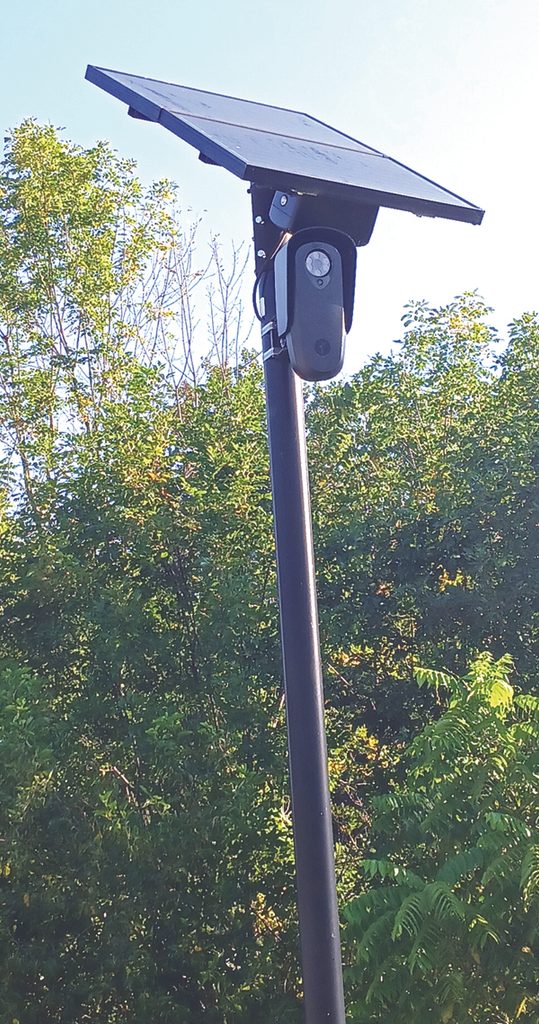
A petition to ban automated license plate readers in rural Lawrence County garnered 500 signatures in four days.
The Indianapolis Metropolitan Police Department is investigating one of its officers for reportedly accessing the department’s license plate network for personal use.
A Jackson County Sheriff’s deputy was fired last month for improperly using to Flock system to spy on a single license plate’s location over 2,000 times. (See accompanying story)
The Bloomington Police Department did not renew its contract with vendor Flock Systems— and other cities across the state are debating whether to do the same.
Public backlash to license plate reader networks is intensifying, but Indiana law says little about how police and commercial entities can use the technology.
The cameras are widely used by law enforcement agencies to capture still images of license plates for criminal investigations.
A state law enacted last year bans homeowners’ associations from deploying the technology to monitor residents and visitors, unless the cameras are operated by law enforcement — the sole restriction to date.
But several lawmakers plan to revisit the subject next year as their constituents express fears of mass surveillance and misuse.
“License plate readers have proven to be a very effective tool for law enforcement,” said Rep. Jim Pressel, R-Rolling Prairie. “It’s something that I think we need to preserve the good that it does, while at the same time putting up guardrails to protect Hoosiers from surveillance.”
The bill will likely require law enforcement agencies to perform regular audits of license plate reader searches to identify misuse, with additional yearly audits by Indiana State Police, Pressel said.
Pressel is also considering minimum standards for how long police agencies should be allowed to retain license plate data and when that information can be shared with outside agencies.
Walker Lasbury, a DePauw University student who is a founder of Eyes Off Indiana, wants lawmakers to set a seven-day data retention limit on information about license plates that do not appear on hot lists — a digital database of vehicles of interest to law enforcement.
That suggestion mirrors the new default storage limit recommended by Flock Safety, the most well-known vendor of license plate readers.
Lasenby said the system’s “evidence mode” feature allows detectives to preserve specific data for active cases, though the company’s own research shows more than 90% of searches are performed within one week.
Eyes Off Indiana estimates 3,604 automated license plate readers are in use across the state, with at least one camera in 84 of Indiana’s 92 counties.
The cameras are accessed by thousands of law enforcement agencies, including hospital and airport security, university police, state prisons and natural resource officers.
The Indiana Department of Correction uses the data to find escapees or parolees who violate the terms of their supervision.
The Indiana Department of Transportation accesses license plate data to monitor tolling operations, construction sites and safety zones.
Police say the systems allow them to locate missing persons, stolen vehicles and homicide suspects.
The Indianapolis Metropolitan Police Department credits license plate readers for the swift apprehension of a serial rape suspect — hours after a national DNA database connected the man to a series of sexual assaults spanning more than a decade.
Indianapolis police say investigators used license plate readers to locate an 86-year-old man who forgot how to get home; three missing foster children whose non-custodial parents were attempting to flee with them to Mexico; and the killer of a 2-year-old Indianapolis girl whose body was hidden in an abandoned southern Indiana home, among other cases.
But the department learned this month that one of its own was using the database for personal reasons.
“I tell people all the time: I don’t think we suspended the Fourth Amendment to the Constitution anytime recently, so we should probably look at this topic,” said Sen. Aaron Freeman, R-Indianapolis.
“Who can have access to this stuff? How long do you keep it?” Freeman said. “When you’re looking for somebody who’s cheating on their spouse, can you use it for that? Somebody runs for office— can we use it for that?”
Pressel and Freeman are among several lawmakers engaging the subject, though it is unclear how many bills will be introduced when the General Assembly convenes in January.
A Change.org petition to ban license plate readers in Lawrence County— population 45,000— attracted more than 500 signatures in just four days.